Sunday, October 29, 2006

Martin Luther Bobblehead Is An Object Lesson For Reformation Sunday

Our Lutheran Pastor, Don Jukam, not only has a sense of humor, but he also knows how to illustrate a point.

At church today during “kid’s time”, Martin Luther - in Bobblehead form - made an appearance in the hand of Pastor Jukam, as we observed “Reformation Sunday.” (My cell phone cam caught the image shown at right following the service.)

All of us kids will not soon forget it.

The “theological” problem with the Bobblehead (where did he ever get one of Martin Luther?), suggested the Pastor, is that his head moves mostly up and down (indicating the affirmative). This is somewhat inconsistent with Luther’s famous declaration to his adjudicator, “No, I will not recant (my writings); here I stand.”

Perhaps a better Martin Luther Bobblehead would have the head only able to move side to side.

In his regular sermon, Pastor Don went on to shed some light on the Reformation. Luther, of course, was not the only Reformer but likely is the best known. There were some before him and many after him. Their shared anxieties were the transgressions of the medieval Roman Catholic Church.

Our pastor graciously pointed out that the then Roman Catholic Church was quite different than today’s Roman Catholic Church (with whom we share many scriptures and salvation through Christ.) Today’s idiom longs for unity rather than schism.

Pastor Don’s primary summarization of the celebrated Reformation focused on its three essentials: Faith, Grace and Scripture. All else, according to Luther, was “adiaphora” (matters that are "indifferent," that is, are not commanded or forbidden by God.)

The practices of the Catholic Church of the 16th century included a lot more than Luther’s stated requisites – among them penances and indulgences that could be purchased and papal infallability. Luther’s study of the book of Romans had convinced him that it was only the grace of God that justified humankind through faith in Christ and his provision of salvation.

That simple but profound belief by Luther was what we celebrated today.

Monday, October 23, 2006

A Café “From the Heartland” Right Here in Port Orchard


There’s a corner café in Port Orchard, at the south end of Kitsap County, that could be comfortably at home in most mid-America towns. It’s Myhre’s Café, pictured above.

My wife’s number was drawn for jury duty this week, and so our dog Buddy and I decided we’d chauffeur her the first day to get the lay of the land. We dropped her off at the hilltop County Campus just before 1pm, and so I decided to drive down the hill and find a spot to have some lunch.

At the bottom of the incline, I coincidentally came across Myhre's Café, on the corner of Sydney and Bay Sts, a block south of the foot-ferry terminal.

After making Buddy comfortable in the car, I walked over to the restaurant. The menu in the window looked good, and the sign said they served breakfast lunch or dinner all the time. My kind of place (I like breakfast food at lunch time).

Plus, I saw that they had “Joe’s Special” (a favorite sauté of mine from Original Joe’s in San Francisco) on the menu, and that sealed it.

Inside, it looked like any café from the heartland. A dark mahogany-stained counter with attached stools was surrounded by tall wooden booths of the same hue. Of course there was a pie-filled pastry case along with ever-moving waitresses who seemed to know everyone by name.

I wondered if my California bud Ed Wall had ever eaten here, as he lived in Port Orchard as a youth and teenager. I’d almost bet on it, as, from his travels, he knows every great eatery in most west coast towns.

The café was founded in 1927, but in 1963 a horrible fire gutted the place. If you look closely at the lousy pic at right (that I took in the dark cafe hallway with my cell phone cam) you might be able to make out the smoke billowing from the building. It was obviously rebuilt soon after and has been in continuous service ever since.

I didn’t know what to expect from a small northwest café with regard to the famous “Joe’s Special,” a hot-pan fried mix of ground beef, onion, scrambled egg and whatever.

Turns out it was delicious, just not quite as “Italian” tasting as down in the Bay Area. But definitely worth a return visit.

While Kay Lynne endured the jury selection process (she didn’t get picked today but must go back tomorrow), Buddy and I drove some seven miles down Beach St and around the point to Manchester State Park.

What a fabulous and beautiful place! The dog had a ball romping along the beach at water’s edge and enjoying every fragrance along the way as I tried to keep up.

Buddy mistook the salt water of Rich Passage for fresh lake water and quickly learned a lesson about life. His tail would be still wagging except that he’s exhausted and is sound asleep on my chair with a smile on his face. Such is a dog’s life.

Saturday, October 21, 2006

My Wife Tolerated LUTEFISK, and I’m Supposed To Be The Scandinavian

Today Kay Lynne spent most of the day at our church, helping serve Lutefisk and other Norwegian “delicacies” to over 1,000 diners who came from as far as California for the event.

The occasion was the 94th annual Lutefisk dinner (actually a fundraiser that has become a renowned event) held at the First Lutheran Church of Poulsbo.

Lutefisk is one of those (Scandinavian) “delicacies” that you either relish – or hate. Like caviar.

For starters, let me explain that the dish is basically a codfish carcass that’s been soaked first in cold water for five days, then in lye – you read right – (actually a caustic birch ash liquid) for two more days and then rinsed (soaked in water) for six more days, refreshing the water daily. It’s now ready for cooking (why would anyone want to eat this?).

On the day of the serving, the remaining fish glob is steam cooked for a time in the oven and then baked in a dish for an hour until it becomes creamy and jelly-like. “To enjoy lutefisk”, they say, it must be spooned onto Norwegian lefse (potato flat bread) that has been covered with soft, boiled potatos. Some require bacon, peppers or hot mustard (or all three) to be added before they can tolerate it.

CAUTION: If you don’t wash the cooking pots and pans immediately after usage, the fish (and odor) may never come off.

My wife said she actually liked it. She even brought home a sample carton of the “delicacy” along with delicious potatoes and lefse. I did eat some, but I much preferred the Norwegian meat balls that she also brought home.

How do you describe the taste and texture of lutefish? It’s not easy. I found this account on a blog:

“Lutefisk is pretty much what you'd expect of jellied cod; it is a foul and odiferous goo, whose gelatinous texture and rancid oily taste are locked in spirited competition to see which can be the more responsible for rendering the whole completely inedble.”

I don’t care for caviar in any form, and even though I’m a Finnlander, I’ll likely not look forward to eating Lutefisk again. I still have a fishy taste in my mouth.

Tuesday, October 17, 2006

Forgiveness… The Way God Deals With Evil


This past weekend my wife and I were in Oregon having fun with our granddaughters. Of course on Sunday we went to church at Newberg Friends Church (bell tower shown) where my son Gregg is senior pastor.

For the most part, for me, the sermon is the element in a worship service that speaks to me the most. The sermon Gregg delivered Sunday was powerful and impacting. If put into effect, it would be life-altering.

The sermon topic was “forgiveness”, and with all the recent media coverage of the Amish schoolgirl shootings by a madman, there was plenty of fodder for discussion. You can find a link to his sermon here or on his blog.

A common response to the Amish acts of kindness and forgiveness (by Christians as well as the general public) has been surprise and incredulity, as well as “he got off too easy” and “he should have had to face execution or spend his life in jail”.

Gregg, however, suggested that the Amish people lived out their faith as it should be. “I see forgiveness as capable of profoundly changing our lives,” he said.

Using a video film clip from Les Miserables, he showed us how, when the bishop voluntarily forgave the professional thief Jean Valjean, it altered Valjean’s behavior for the rest of his life.

We looked at the ancient Biblical example of Joseph, who forgave his brothers for selling him into slavery in Egypt (from which he became a powerful ruler).

In both of these examples, as well as with the Amish, forgiveness was imparted before it was even asked for. And this is the revolutionary, counter-cultural aspect of Christ’s teachings.

In Christ’s time, Judaism dictated that forgiveness was not automatic; in fact, it required earning by the wrongdoer with genuine attempts at atonement. In that context, a murderer was forever doomed with no opportunity for atonement to a dead victim.

However, God, through Christ, extended forgiveness and atonement to each and every one of us, “while we were yet sinners” and even before we asked for it. That’s the astounding way God deals with evil in the human race.

Does this mean evildoers get off scot free? Hardly.

One of Gregg’s seminary professors, Miraslov Volf, a native Croatian personally affected by the war in Kosovo, has written a poignant book titled, Free of Charge. In it, Volf says, “In the very act of forgiving, there is an act of condemnation.”

Gregg went on to paraphrase what Volf wrote with these words: “Forgiveness does not ignore or white wash or overlook wrong actions. It is not weak or whimpy or blind or fake. Forgiveness takes the bold, courageous first step of naming wrong as wrong, of condemning an evil action as being evil…and in the very act of naming it as wrong, forgivenss chooses not to demand payment of the debt the wrong act incurs.”

“Forgiveness,” Gregg taught, “names someone’s actions as wrong, but makes the choice not to forget, not to bring vengeance, but instead to release the other from the debt they owe.”

When a repentant wrongdoer does ask for forgiveness, the opportunity for reconciliation is then possible. But with or without repentance on the part of the wrongdoer, the act of forgiveness is a powerful and life-altering practice for our culture.

Thanks be to God.

Friday, October 13, 2006

Are Auto Extended Warranties Worth It? Only When Needed – But That’s the Point

Today I am singing the praises of automobile extended warranties. Of course it’s only because it paid off to the tune of 300%.

We seriously debated the merits of such a policy when we acquired our “pre-owned” Acura MDX almost three years ago. The main reason was the healthy chunk of premium – almost $1,500 – but it would last three years or up to 100,000 miles, whichever came first.

All drive line problems are covered, plus a few other things, but not including tires, batteries, etc. The only caveat is that you have to maintain the car according to manufacturer’s recommendations.

Hmmmm. No major car expenditures for at least three years. We decided to buy it.

As fate would have it, the engine warning light came on a few weeks ago while I was creeping in traffic approaching the Narrows bridge. I took it to a local guy who said the diagnostic code indicated I needed to take it to an Acura dealer. Uh oh.

Long story short, the entire transmission and 4WD transaxle needed to be replaced. The estimated tab? $4,895. Yikes.

“Is it covered by my warranty?” I asked. “I’ll check it out,” came the reply. After a seemingly "agonizing" wait of only a few hours, I got the news.

“You’re covered fully,” the technician said. “We’ll even provide you with a loaner at no charge”. Whew! Thank you, Lord.

Yesterday afternoon we picked up our MDX with a basically brand new drive line. It runs like a dream. The line of ciphers at the bottom of the invoice was icing on the cake.

Now I’ve got another “problem”. The loaner Acura had satellite radio on it. I only drove it for 10 days, but I’m hopelessly hooked. Gonna check it out for the MDX this afternoon.

Monday, October 09, 2006

Re-Drafting My Spiritual Formation – Log #11: Context is Critical and Perspective is Principal

Once again, our Lutheran pastor has shed new light on views I’ve likely misappropriated for most of my life. As we learned in the sermon yesterday, context is critical and perspective is principal.

The sermon text centered on Jesus’ rather explicit comments on marriage as recorded in Mark chapter 10: “Whoever divorces his wife and marries another commits adultery against her; and if she divorces her husband and marries another, she commits adultery”. Yikes. Uncomfortable words in our culture.

The Pharisees had tried to get Jesus in political and religious trouble by asking him if it was “lawful” for a man to divorce his wife.

This text, along with others on interesting transgressions (like homosexuality and fornication), are often selectively used by conservative Christians as standards for behavior of their fellows, even at the ballot box.

Before you come unglued, hear me out. I am not condoning ANY sin. But in his comments yesterday, our pastor beautifully painted “the big picture” of God’s grace.

He indicated that we don’t know for sure, but the reason this issue may have come up at all, was because Jesus had traveled to Perea, the area governed by Herod Antipas, who married Herodias, the wife of his own half-brother.

It was Herodias who cunningly caused the death of John the Baptist. So, in this context, you can quickly grasp why the question arose where it did.

The perspective offered by our Pastor was what particularly hit home for me. He pointed out – as we should know only too well – that there is not one of us who doesn’t sin. The lesson from the above text, he suggested, should not focus on the particular shortcoming. Rather, it is broader than that.

The full message of the Gospel is overwhelmingly one of forgiveness and reconciliation, and that’s where our center of attention should be as well.

Christ died for our sins – every single one and for every single person. Our task as followers of Christ is not to focus on a few selective sins of church members or public officials or anyone but instead to communicate and participate in the encompassing Gospel message of pardon and restitution which is available to all.

The grace of God has freed us to so live. Thanks be to God.

Tuesday, October 03, 2006

Does Our Living Reflect Our Faith Values? – Still More On “The Centered Life”

My current adult Sunday School class on The Centered Life continues to stimulate thought and motivate changes in the way I live. In a recent post I marveled how that it is God’s grace that frees us to live out our vocation (the Christian life).

Last Sunday our class broke up into small groups and we did some self examination. We made a list on the left side of the paper of five of what we considered to be our (faith based) values (e.g., family, devotion to God, kindness, service to others, etc.). Then on the right side of the sheet we listed the ways in which we spent our time, daily and weekly.

The point was to ask ourselves if someone else read the list, would they conclude that we lived according to our stated values? Try it sometime. It’s a revealing exercise.

Chris Bellefeuille, pastor of a large Minnesota Lutheran church observes the following:

“If you think of every moment of your life as a moment of discipleship, it can be a bit overwhelming. But every moment of your life is an opportunity for discipleship. God has given each of us many great gifts: time, money/material things, relationships and our particular talents. As Christian people, we use all of these gifts to live out our values in the world.

He continues, “Think of discipleship as minute-by-minute stewardship of these gifts: how are they being spent, to what purpose are they being directed?” (Bold mine)

This is the challenge I’ve been pondering so far this week.

Parker Palmer, a Quaker educator and personal friend of The Centered Life author Jack Fortin, has written a helpful book titled, Let Your Life Speak: Listening for the Voice of Vocation. He describes how we can look inward to reflect on our own life experience and listen for the inner voice that reveals our various callings. In it he states, “That insight is hidden in the word 'vocation' itself, which is rooted in the Latin for ‘voice.’ Vocation does not mean a goal that I pursue. It means a calling that I hear.”

May my eyes and ears be open, moment by moment, to living in God’s grace.

Saturday, September 30, 2006

I Finally Have a FISHING Boat


They say three times is a charm, and that’s exactly what it took to turn my Arima into a fishing boat.

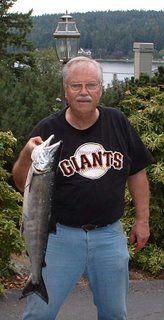
I had the boat out on salt water today for just the third time, this trip with my son Doug. The skunk came off the vessel at 1:30pm east of Jeff Head, in 104 feet of water, on a green/silver Coyote spoon trolled behind a flasher some 45-feet beneath the surface on my downrigger.

The fish was an ocean grown Chum salmon, weighing 8+ pounds and measuring just about 30 inches in length.

Chum are the hardest fighting, per pound, of the various species of salmon available in Puget Sound. This guy lived up to his reputation, making three powerful runs, once trying to go deep under the boat, before he finally tired enough for Doug to deftly net him.

I owe getting the fish in to Doug, because while I was focused on something else, he saw my rod tip start to dance and watched as the fish snapped the line off the downrigger clip with a powerful strike. It was he who grabbed the pole and firmly set the hook that then gave me a chance to have a lot of fun while the fish made its runs. Thanks, son.

Chum are said to be the least desirable of the area salmonoids for eating, but Doug wanted to check it out. We filleted a slab and threw it on the barbie after marinating it a bit in his secret salmon sauce.

The fish tasted just fine. Probably due mostly to his tasty marinade. It didn’t hurt that we bled the fish immediately and kept him cool in the fish box till we got him home, where Doug took the above pic. It’s hard to goof up fresh salmon just out of the water.

I love living in the Northwest!

Wednesday, September 27, 2006

Two More Boat Firsts

Yesterday was another boat first in a couple of ways: a) we took the boat out in a fresh water lake (rather than the salt water of Puget Sound), and b) our dog Buddy went along.

First mate Kay Lynne did just fine in helping me to handle the boat, but as you can see in the photo, Buddy never quite got his sea legs. He did make flawless jumps onto KL’s lap every time we were rocked by speedboat wake waves.

I wanted to get a handle on the trout population at Kitsap Lake near Bremerton. They’re there, but we didn’t have a fish fry for dinner.

This time I just trolled deep, looking for the big ones, but luck wasn’t with us. We did enjoy a couple of hours of gorgeous sunshine, northwest scenery and viewing lakeside homes. One palacious estate had its own seaplane at dockside.

When we pulled the boat out, I asked around for the best baits to use for trout. “Use pop gear and trail some power bait,” one guy offered. “You can’t keep ‘em off your hook!”

Right.

But then, I didn’t want the “plants” he was talking about; I was looking for the “big daddies”.

Tuesday, September 26, 2006

A Fresh Perspective Can Be Liberating

Taking a mind trip through my 55+ years as a Christian, I can’t recall a time when there wasn’t some kind of an “onus” on me. I fully realize that, indeed, the “onus(es)” may have been illusory, or even self-induced, but then again I’m not sure.

It all depends on how one looks at things spiritual. I’ll try to explain.

Even though I was fully cognizant that salvation itself was a gift from God, I always felt that I had to hold up “my end of the bargain”.

In grade school, I couldn’t cheat because, even if I got away with it, God was watching. In high school, I needed to carry a Bible among my books “to be a witness”.

In college I needed to develop a solid apologetic for my faith so I could “defend the faith” (not surprisingly, often weakly). After I got married, it was important to “establish a Christian home”. At work, I needed to “act like a Christian” in a supposed effort to be “salt” in the world. After retiring, I needed to figure out how I could possibly still be of any use to God. And on it goes.

Note the (misplaced) emphasis was always on what I had to do.

In contrast, the Lutheran perspective, that my wife and I are richly discovering, maintains that it is the grace of God which frees us to live out our “call” or “vocation” (see last post). What?

Did you say the grace of God FREES us to just live? That’s indeed what Martin Luther – and other reformers – believed and practiced.

This fresh perspective may appear to be semantic or oversimplified. But to me it is revolutionary and liberating.

The emphasis is not on me or I or what I have to do. I am free to just live, with God as my center, in a world that he created and in which he continues to creatively involve himself (read Psalm 104).

I am part of his continuing creative work (as are you). Now, in a fresh way, I am free to immerse myself in it.

Monday, September 25, 2006

Free To Live Out Our “Call” – More on "The Centered Life"

Yesterday I again attended our adult Sunday School class on The Centered Life. The concept is gaining clarity and meaning for me.

With God as our center, as Christians we are freed from the need to earn our salvation or justify our existence on earth. The Lutheran tradition suggests that through God’s grace we are freed to live and serve our neighbor.

A 1993 ELCA (Evangelical Lutheran Church in America) statement on “vocation” maintains that God calls all Christians to a life of vocation. Vocation in this context means “living out one’s call.”

Lutheran thought conceptualizes “vocation” or “the Christian call” as transpiring in FOUR domains: our workplace, our home, our community and our congregation. We spent a lot of the time yesterday massaging the first – the workplace.

Jack Fortin, author of the book of the same title as our class, defines “workplace” as “wherever we spend a significant portion of our time, engaged in activity (whether compensated or not) that produces goods and services, that makes use of our God-given talents and that provides us an opportunity to serve God’s purposes in the world.” Wow. That even includes us retired folks!

Fortin then explains that God calls us in individual ways that often fit our own unique personalities and situations. However, God’s call can take many forms.

Peter the fisherman was called in a whole new direction as a disciple and subsequent apostle. Zacchaeus, on the other hand, was called to live differently in his same occupation. Frederick Buechner thinks our calling lies in “that place where our deep gladness meets the world’s deep need”.

How, then, should we discern and live out our own call?

That is my ponderance for this week. Lord, give me sensitivity, understanding and the freedom to live it out.

Thursday, September 21, 2006

September Showers Interrupt Piscatorial Fancies

Several days of rain and showers this week have kept my thoughts away from the boat and fishing. Besides, we’re doing the final prep work for new counter tops in the kitchen. But it’s predicted to clear up tomorrow through the weekend, and one never knows what might happen.

Fall weather definitely arrived this week with cooler temperatures along with the moisture, and that means that the water temperatures in nearby lakes will correspondingly drop. I’m anxious to try Kitsap Lake near Bremerton, known mostly for its bass and spiny ray populations.

What’s not as well known is that the Washington DFW at least annually stocks the impoundment with trout of various sizes, including triploids, but the problem is locating them.

The lake is large enough and deep enough to accommodate trout year around, but it is somewhat of a mystery where they go during the warm summer days when jet skis and water skiers abound.

If they go real deep, there is usually less oxygen than needed for sustenance. Somehow they manage to find the right level in the thermocline that is both cool enough (60 degrees or less) and yet contains enough life-sustaining oxygen.

With the water sports enthusiasts finally diverted to other seasonal interests, now may be a perfect opportunity to scout out the trout that made it through the heat of summer and have grown even larger.

For a month or two, as water temps gradually decline, the trout lines need to get wet. The fish will instinctively be foraging for food before the lethargy of a cold-water winter sets in. Maybe I’ll get a chance to give it a try.

Unless the ocean Coho salmon start rounding Point No Point first (check last post).

Wednesday, September 20, 2006

Is the “Balanced” Life a Myth For Christians?

I attended a new adult Sunday School Class for the first time this week. The subject matter has been on my mind ever since.

Our study is based on the book, The Centered Life, by Jack Fortin, a Lutheran scholar. One of the benefits of joining a church of a new denomination has been and continues to be the exposure to fresh (for me) Christian thinking.

In his book, Fortin points out that most of us futilely seek a “balanced” life. Our new buzz word is “compartmentalization”. We try to walk a tight rope, giving ample time and focus to home, family, work, kids, politics, education and a social life. Is it a wonder most of us live a tension-filled life?

Rather, suggests Fortin, as Christians, we should seek a “centered life” – centered on God, through Christ, who created us. The Church at its best, he feels, is the place where we can find and practice this centering.

Fortin proposes that there are four dimensions to the “centered life”—
· That we are awakened to God’s presence in our life
· That we are called to live our faith in every situation
· That we are set free to contribute our unique gifts to God’s work in the world
· That we are nurtured and supported by a community of faith

For me, this is a nuance in my faith journey that I’m looking forward to not only exploring, but also to hopefully put into practice. I’m looking forward already to Sunday.

Sunday, September 17, 2006

Bobbing Like A Cork In A Washing Machine

Yesterday my son Doug and I fished for Coho salmon in my recently acquired Arima boat. The story of the day, however, was weather-related, not fish-related.

After launching around 7am at slack tide, we headed some 10 miles from the ramp to Point-No-Point (PNP) at the northern tip of the Kitsap Peninsula.

The massive amount of sea water that flows into the entire Puget Sound with each incoming tide passes through the channel between the PNP lighthouse and Possession Bar at the south tip of Whidbey Island some four miles to the northeast.

Of course that’s the spot we chose to fish. When the ocean grown salmon come into the Sound from which they make their upriver spawning runs, they have to come through here. Right? Right, IF they are coming. Unfortunately, they’re not migrating quite yet.

But back to the non-fish story. The day started great – fairly calm, not much wind and a slight cloud cover. Nothing out of the ordinary was forecasted.

By 9:30 or so, however, the tide was moving in at close to 10 knots, and a 20 mph wind had come up directly contrary to the tide. When this happens, mother nature is not smiling.

Combine the aforementioned with the incredible rip tides that occur in the area along with the rolling wakes of ocean freighters, and you’ve got liquid mountains of swelling, roiling chop.

It takes every nautical skill you have to man the boat, the downriggers and your lines when the vessel is tossed about like a cork in a washing machine.

In spite of it all, Doug managed to hook an apparently large Chinook that stubbornly stayed down and eventually broke his leader. We took solace in the fact that, had it been a Chinook, we would have had to return it to the water (Kings are not in season there). And he got one dog fish (small pesky shark). We both threw back several shakers (juvenile Chinook).

The boat performed wonderfully, even in the tumultuous waters, despite the fact that it’s only 16-feet long. We never felt unsafe – just a bit queasy at times.

When it finally calmed down in mid-afternoon, I snapped the above photo of Doug with my cell phone (and then made a phone call on my fish-finder :-). We’ll get the Coho next time.

Thursday, September 14, 2006

The Air Up Here (In the Northwest)

Earlier this evening, as light was fading, I walked out on our front porch and was immediately swathed in our exceptional Northwest air. There is nothing quite like it.

I took a long, deep breath. And I did it again. And again.

Northwest air actually has a wonderful fragrance. It is at once fresh, clean, moist, crisp, cool and is permeated with oxygen and ozone from the forests and seasoned with a perfect tinge of saltiness from Puget Sound.

I believe if you could bottle its bouquet, you could get rich marketing it.

Northwest air is invigorating – right down to your core being. It’s also rejuvenating. Get some exercise while breathing it, and you’ll sleep like a rock and wake up refreshed. It’s also addicting. You can never get enough of it.

As Buddy our dog bounded back up the stairs after refreshing himself, I enjoyed one last deep breath. The air up here creates a pleasurable experience even out of routine things. And I am thankful to be here.

Tuesday, September 12, 2006

Fishing for Men and Women

I’ve often wondered about Christ’s suggestion that we should be “fishers of men” (and women, too, of course).

Reason is, I’m a fisher, and “fishing” can often be rather brutal on the target. As beautiful and enticing as the bait or lure may appear, the hook is rather sharp and usually effectively permanent.

Of course we need to acknowledge that “fishing” has changed somewhat from what it was two millennia ago. In Christ’s time, large nets were used as the primary means by which fish were harvested.

Once a school was located (without an electronic fish-finder, interestingly), a net was thrown out, and the fish were gathered onto the shore or into a boat, sometimes even threatening the vessel’s capacity.

What has always caused me wonder is thinking about how we are to carry out this directive with regard to people. How do we locate possible “prey”? Will our targets respond in unison as a school of fish does? What is the modern equivalent of the large, casting nets? And are we to “herd” unsuspecting victims into the kingdom?

Admittedly, the questions are rhetorical. Of course reason tells us that our Lord’s imperative was allegorical rather than literal. And I've so far not even acknowledged a critical ingredient in Christ's proposition.

"Follow me", he urged, "and I will make you fishers of men". If we are true followers of Christ, then we'll likely be living our lives in ways that the Gospel will be seen as being appealing -- or at the least something worth exploring.

I’ll probably reflect on this again sometime when I’m out fishing. Maybe it would be even better if I invited someone along who might be interested in engaging.

Wednesday, September 06, 2006

Bible Study Provokes Thought and (Hopefully) Action

We often think of Jesus as a perfect model. It isn’t often we encounter his humanness.

Last night in our men’s Bible study at church, we discovered a very interesting (and for many of us, overlooked) aspect of Christ’s ministry. Our focus was on the second chapter of Mark’s Gospel where Jesus deals with the Syro-Phoenician woman who wanted help for her demon-filled little daughter.

A Greek woman, she had come down to Tyre where she must have heard Jesus was. Truth be told, Jesus was there trying to avoid the pressing crowds and to get some rest. But the woman would have no part of it. She begged Jesus to drive the demon out of her daughter.

In fact, the Matthew account of this incident says that Jesus initially ignored her requests and that the disciples actually asked him to “send her away” because of her loud, distressed cries. The Lord’s apparently stark and harsh response was what astounded us last night.

“First, let the children eat all they want”, Christ told them, “for it is not right to take the children’s bread and toss it to the dogs.” In Matthew, his response was, “I was sent only to the lost sheep of Israel”, which sort of explains what he meant in Mark’s version.

But it also raises a LOT of questions.

Why did Jesus avoid this apparent opportunity to show his power in ministry? Did Jesus really “look down” on Gentiles as is implied? Or does this event simply show his weariness, frustration and humanness? Why didn’t he act immediately? What is going on?

Of course when the woman answered the Lord by saying, “but even the dogs under the table eat the children’s crumbs,” Jesus responded with wonderful and comforting words. “For such a reply (which exhibited her great faith), you may go; the demon has left your daughter.”

The episode ends well, but the trail sure took some interesting turns. We spent quite a bit of time discussing what we can learn from this occurrence. Among many possibilities, the myriad of relationships between faith and works (especially from Luther’s perspective) emerged as a worthy ponderance.

Because we are justified by faith, we should now act accordingly, rather than "resting on our laurels". Faith, if it is not accompanied by action, is dead, says the book of James.

Monday, September 04, 2006

Inaugural Voyage For New (To Me) Arima Boat Gets An A-OK

In my last post, I mentioned that I hoped to get the Arima in the water sometime this weekend. Good thing it was still part of the holiday “weekend” today, as we launched her this morning.

My cousin Joel Narva joined me for the inaugural voyage, and we pronounced it a splashing success at day’s end. We even caught fish, albeit not the kind we were after.

In reality, today’s trip was a bit stressful. Whenever you acquire a used boat, there are a multiplicity of things that need checking out. Hull, main engine, kicker, radio, depth/fish finder, batteries, switches, downriggers and bilge pumps all need scrutiny. Most importantly, how does she handle the waters of Puget Sound?

Just fine, thank you. All systems are a-ok.


We even caught fish – dog fish! (Puget Sound small annoying sharks) Pic at right shows one of three that managed to spoil our fun. I couldn’t figure out why they would hit a salmon lure until we saw half of a “shaker” (a salmon too juvenile to keep) on the hook with the shark. The small Chinook hit first, and the shark took advantage of easy prey.

Above left is Joel manning the tiller handle of the kicker as we trolled through fairly calm waters for about four hours. The best news is that the boat passed the test with flying colors. We’ll get the Coho later when they finally get here. We might have been a tad early for the ocean fish.

Saturday, September 02, 2006

A Great Time of the Year

The past couple of weeks have been as good as they get for us older folks. And of course the vast majority of it had to do with kids and grandkids.

It began, however, with my finding a highly-desired Arima fishing boat with just about everything on it that I need to fish. Then I got to spend two solid days with my son Gregg, helping drive his new-to-them RV home to Oregon from Colorado.

Then Gregg and Elaine and family came to visit, and to make it even better, our granddaughters were able to stay over for a few days of fun activities after their parents had to return home. And our other son Doug and his wife Jamie came over while all were here, giving us the cherished time with the whole family together.

We finally took the granddaughters home via Amtrak this past Tuesday (note the kid-empty train car above on our return trip), and since then I’ve focused on getting the boat ready to fish. I hope to get it in the water maybe sometime this weekend.

Hope y’all have a great holiday weekend! Why do we NOT work on LABOR DAY? It’s a question for the ages.

Wednesday, August 30, 2006

Fun With Granddaughters

The past three days have been nothing but fun with our sweet granddaughters who remained here in Washington with us after their parents left last Saturday. We enjoyed having the whole family here, including mom and dad (son Gregg and daughter-in-law Elaine), for much of last week.


That's Hayley and Talli above left at Seattle's famous waterfront Aquarium on Monday, and at right just above is Aubrey "the Octopus" at another part of the aquatic exhibit.

A little later in the day we took in the Space Needle and enjoyed lots of rides in the Seattle Center amusement park. The girls especially enjoyed a visit from their uncle Doug and aunt Jamie who stopped by the Center for a time in the afternoon.

Unfortunately for us, the fun times came to an end yesterday as Grandma and Grandpa accompanied the girls on an Amtrak train trip home to Oregon, a first for all three of the young uns. It was a great experience for all, although the grandparents were ready for the sack last night after eight hours on the train.

To Amtrak’s credit, they have made travel by train quite acceptable (we had opposing seats with a table between for eating and games), but they certainly are not as customer-friendly as are airlines.

As an example, you can make and pay for Amtrak reservations online, but instead of issuing an actual ticket with a seat assignment, you can only print out a voucher. Then you have to wait in line at the station to convert the voucher to a ticket and then stand in line again to get a seat assignment. Kinda redundant.

Unfortunately, Amtrak is still an ego-centric corporate monolith rather than a customer-friendly company like Southwest Airlines or Jet Blue. Too bad for Amtrak, as they could be attracting a lot of travelers right now, but alas.