Friday, March 31, 2006

Back At Home From Disneyland and Knotts Berry Farm


You meet some incredible people at Disneyland and Knotts Berry Farm. At left is our youngest granddaughter, Aubrey, getting a hug from Snoopy himself on Wednesday at Knotts. She was excited beyond belief.

Our entire family is all back at home now after several wonderful days at the "happiest place on earth". We jammed three full days with nothin' but fun and even got soaked in the rain in SoCal, but it turned out to be a blessing in disguise (no lines).

In the days ahead I'll blog more on the subject and throw in a few pics as well. Suffice it to say that it was simply wonderful to have our two sons, their wives, and three granddaughters all together in a place like Disneyland.

Gregg and Elaine and Doug and Jamie are still kids at heart and we really couldn't tell who was having the most fun -- the "adult" kids or the real kids. And it didn't matter. Watch for more in the days ahead.

Tuesday, March 14, 2006

Applecart Upset

As Christians in the affluent western world, we can’t help but be influenced by our society. As we make various attempts to try to “live like Christians”, often our efforts bear little fruit.

Even “organized” efforts like the fairly recent WWJD (What Would Jesus Do) “campaign” may point us to reflect on the problem but at the same time does little to provide insight into how Jesus (or God) would actually want us to live our lives.

Last Sunday my son Gregg (who is a Friends pastor in Oregon) gave a sermon on the topic that kind of reminded me of the old phrase “applecart upset”, though he titled it something else. Here’s a snippet of what he said:

“My (recent) life … has been one of God yanking me out of the easy path I seem to map out for my life, and sending me down a road that I was not expecting and that involves sacrifice…. The heart of following Jesus is radically different than the way most of us live our lives. Following Jesus is not something which gives us a power or a tool to having all that we ever wanted in life.”

If that’s not enough to make you click here to read his entire sermon as he delivered it, then so be it. But if not, you’ll be missing some great insight on what it means to be a follower of Christ in our “success-driven” society.

Monday, March 13, 2006

Re-Drafting My Spiritual Formation— Log #5: Finding Meaning in Worship

At church last Sunday I was once again blessed with the worship liturgy and meanings gleaned from it. The season in the church calendar now being Lent, inside the front page of the bulletin was a considerable explanation of this time of year and its related significance for us as members of Christ’s church.

During my decades in “evangelicalism” I had become used to what I now refer to as the “shotgun” approach to meaningful worship. The theme for the day or month usually reflected what the church leadership was “led to focus on” at the particular time. Not all bad, I admit. But I personally often didn’t feel “in sync”.

In the mainline church that we now are attending, the focus of worship is guided primarily by the church calendar – something with which I was relatively unfamiliar until recently. In my past church life, Lent was usually casually noted by condemnation of Fat Tuesday, the culmination of Mardi Gras in New Orleans (and elsewhere) and a reference to Ash Wednesday, Lent’s official beginning. Other than conversation now and then among friends about what we were "giving up" for Lent, we usually heard nothing about it until Holy week. And even then, there might only be a Good Friday observance of some sort just prior to Easter – which WAS, of course, rightfully emphasized.

As I have alluded to before in these posts, this new (to me) practice of allowing the church calendar and time-tested liturgies to illuminate our worship experience has provided a wonderful catharsis for my faith journey. Last Sunday was no exception.

The “Order of Worship” consists of three components. First, the Entrance Rite where “God Gathers Us”; secondly, the Service of the Word where “God Speaks to Us”; and, thirdly, the Closing Rite where “God Sends Us Out to Serve”.

In the Gathering Rite we share hymns and prayers of confession, forgiveness and self-examination. In the Service of the Word, we open our thinking to three extensive Scripture readings -- from the Old Testament, the New Testament and the Gospels -- and recite together the ancient creeds of our faith. The pastor usually follows with the sermon. In the Sending Rite, with hymns, shared prayers and the benediction, we are commissioned to daily service as followers of Christ.

Of course the Scriptures and liturgies are appropriately reflective of the liturgical season, but the consistency in the order of worship takes us through the important elements of encountering and listening to God each and every time we worship.

I find the experience uplifting, strengthening and sustaining. And for an old “evangelical” like me, very refreshing. Thanks be to God.

Wednesday, March 08, 2006

Granddaughters – A Wonderful Gift from God


This past weekend my wife and I were in Oregon, and we had the wonderful experience of spending some valuable time with our three granddaughters. We were primarily there to help out a bit while our daughter-in-law was at a women’s retreat at the ocean.

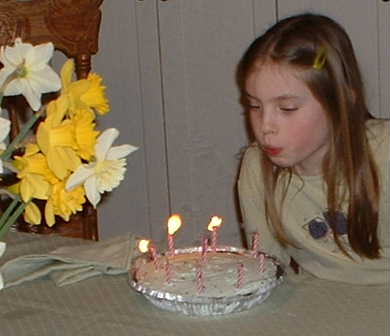
We thoroughly enjoyed all three of them, but this was a special time for Hayley. It was her 9th birthday on Monday. In the photo above right I caught her in the midst of blowing out her birthday candles. She got them all out with nary a problem!

Hayley is a very gifted girl. She loves and is good at a wide variety of interests, not the least of which is her computer proficiency. Got a Mac issue? Call Hayley.

Her special day wasn’t even affected much by the fact that she was feeling a bit “under the weather”. As is Hayley, in spite of how she felt, she still had fun and in the evening got to open and enjoy some presents from family.

Hayley was also recently honored by having her term project on display at her school. I may have mentioned it in a January post, but above left is the photo of her efforts which I snapped at the school.

She had carefully constructed a Motte and Bailey castle and did a marvelous job. Way to go, Hayley! Click on the castle name in the previous sentence if you are like me – wondering what a Motte and Bailey castle is.

A perfect “capper” for our long weekend was last night’s middle school band concert in which Talli (the eldest) is a member of the trumpet section. Little Aubrey ran out of steam about half way through the concert but did get to see her big sister blow her horn.

In case you hadn’t noticed, grandparents really get off on these kinds of things!

Wednesday, March 01, 2006

Thankful For Days Like This

Today I went to the big city – well, through it, actually. The trip began with a gorgeous ferry ride on the MV Wenatchee into Seattle. I say gorgeous because the skies were blue with wispy, white clouds, the azure water was quite calm, and the sun radiated welcome warmth, as the temperature was on the cool side.

From the Coleman dock where the auto-laden vessel touched the bank, I headed south through the cargo-ship-lined port, past Boeing field, and then onto the freeway near the Southcenter Mall. I was heading for the southern burb of Federal Way where the headquarters of the global relief organization, World Vision, is nestled in a stand of tall pines and firs – on Weyerhaeuser Way, appropriately.

My mission was to meet with a senior magazine editor who had indicated there might be some writing opportunities for one of their publications. She said that “outside writers” often provided a “fresh” perspective that was good for everyone concerned. That was music to my ears.

Of course I love to write – as witnessed by this blog. But here was a chance to use what one really enjoys doing to hopefully be a small aid in a wonderful and worthy cause.

We talked for some time about the organization and how she came to be a part of it. She’s a southern California gal who came north with World Vision when it moved to Seattle in 1995. I mentioned that my tie with World Vision was that I had personally met and spent a bit of time with its founder, Bob Pierce, back in the early 1960’s

We then chatted about her goals and aspirations for the journal. I was easily hooked as we rather quickly found resonance on an issue close to both of our hearts that fits well within the scope of her objectives.

So now I have a writing “assignment”!

Having discussed the subject on several occasions with friends and with my sons who are in ministry, my mental wheels were spinning as I drove home. I enjoyed taking the longer drive around the Sound – rather than returning on the ferry – because it gave me a few added moments to savor the experience and listen for the thoughts of God on the topic we had agreed upon.

For the next several months I’ll know exactly what to do with any “spare” time. I’ve already started an outline and put a few ideas down on paper. I’m really thankful for days like this.

Sunday, February 26, 2006

Re-Drafting My Spiritual Formation—Log #4: Watching For “The Rapture”?

My childhood took place in a Fundamentalist venue. My parents and much of our extended family believed the Bible literally. I wish I had a dollar for every time I heard a preacher say, “God said it, I believe it, and that settles it!”

Unfortunately, if you took what the Bible says literally, not only did it not settle much anything, but often more questions arose than were answered. One of the areas of perpetual concern for us was “end times” doctrine.

Are we now living in the “end times”? Are world conditions falling into place to facilitate Armageddon? What is going to happen next?

Fundamentalists – and many dispensationalist evangelicals – believe that the next major eschatological event will be “the rapture”. This is the "predicted" future occurrence when Christ appears in the heavens and calls “true” believers, along with the “dead in Christ”, up, up and away from earth to be removed from the hideous things that will then take place on this planet - such as the battle of Armageddon.

Then, after a period of time with Christ somewhere in the heavens, all Christians of history would return to earth with Christ for his millennial reign – a true theocracy. Somewhere in that time line, however, would occur a great judgment where true believers would be given eternal life and non-believers would be sent away to roast forever. Not exactly comforting thoughts.

As a young boy, I can often remember waking up in a cold sweat in the middle of the night from a nightmare in which the sky had suddenly become brilliantly bright accompanied by incredible thunder and lightning. I expected to see Christ himself walking on the clouds and reaching out to me, but instead I would always wake up in my dark bedroom wondering what had happened and why I was soaking wet.

The imagery no doubt was from an old black and white movie called The Rapture (redone several times through the years, I think, by well-meaning film makers). This movie was somehow ok to view in church, flickeringly screened from a noisy 16mm Bell & Howell or Revere projector. But we dared not go to a theater to see really good films.

Fast forward some five decades. I still continued to wonder about “end times” and “the rapture” – especially with the likes of current evangelical TV prognosticators like Hal Lindsey, Jack Van Impe and others. Of course I wasn’t alone. Millions have swallowed the conjectures put forward by Tim La Haye and Jerry Jenkins in the Left Behind book and film series.

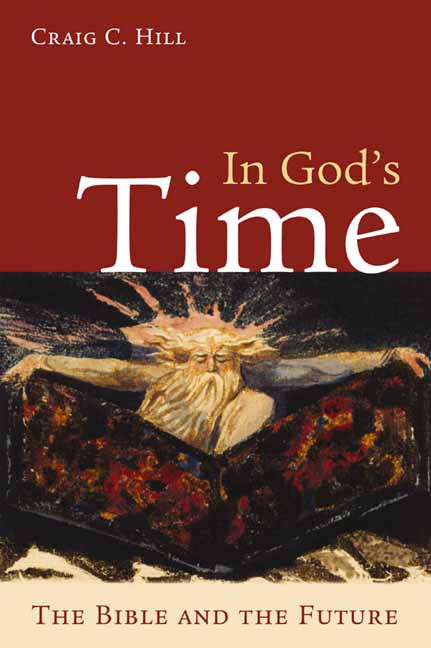
I’ve recently completed reading a book by Craig C. Hill, a brilliant New Testament professor at Wesley Theological Seminary in Washington, D.C., titled, In God’s Time. It’s the best read I’ve come across to help (me) sort out a great deal of (apparently widespread) convoluted thinking on the subject.

Tony Campolo says of the book, “At a time when popular books on the second coming are leading to confusion and a right-wing political mind-set, here is a book that is balanced and inspiring and helpful”. Eugene Petersen, author of the acclaimed paraphrase The Message concurs, saying the book provides guidance “through the verbal clutter and emotional hysteria” of end times thinking.

I’d suggest reading the book for yourself; however, you can get some preliminary info here. Obviously, I can’t do its content justice in a paragraph or two. In a nutshell, Hill suggests that if you try to understand “end times” prophesies by a literal interpretation of the Bible, you’re in a pack of trouble.

Here’s just one thing from the book that astounded me but at the same time gave me hope for a rational future. You won’t find “the rapture” in the New Testament – or in the entire Bible, for that matter.

The idea of TWO returns to earth by Christ (the first being “the rapture” and the second the millennial reign) was invented by 19th century fundamentalists because it was the only way they could make literal interpretations of scriptures fit into their kind of coherence.

A lot of the problem is that much of Biblical prophecy refers to the nation of Israel and was applicable (and probably fulfilled) during and just following the first century. But these same prophecies, if appropriated to the “church” – as do many of the aforementioned prognosticators – could be very well misapplied.

As I said earlier, you need to read the book yourself to capture its impact and perspective. Craig Hill also suggests that we as Christians might be far better served to be living every day for the Kingdom of God rather than trying to comprehend if Magog is Moscow or if Armageddon is around the corner.

Far better that we love our spouse, our neighbor or our co-worker and express it with action as refletive of Christ's love for us, than to lie awake at night waiting for the rapture or for a seven year peace treaty between Israel and the Arabs.

Wednesday, February 22, 2006

The Blast Blew By (You?:-)

Not great humor in the head, but for anyone who cares, our “Arctic blast” came and went without significance. Oh, it did get a bit chilly at night for a few days, but the sun came out beautifully in the day time to make the temps tolerable.

Of course when the warmer weather came back a day or two ago, so did the clouds. It’s the clouds, say weather wags, that keep the heat down where we can feel it. Without clouds, heat rises and disappears. I assume they mean in the winter, as I’ve been through a lot of blazing hot August days that had no clouds.

With my wife busy with her family for a time, I’ve got ample time this week for reading. Currently I’m paging through Craig Hill’s In God’s Time in which he pretty well bulldozes concepts propogated by some well known evangelical “end times” authors.

It’s interesting how one’s perspective can be enriched when biblical texts are understood in their cultural and religious contexts. Look for a post on the subject sometime soon (yawn:-).

Thursday, February 16, 2006

Waiting For the “Arctic Blast”

For several days now, here in the northwest, weather wags have been talking about an approaching “Arctic Blast” of dry, cold air that is supposed to arrive later today and last till at least noon on Sunday.

I’m getting a big kick out of the media “experts” who, instead of focusing on real issues, waste theirs (and our) time with atmospheric drivel.

On the radio yesterday, when my wife, Buddy (our dog) and I were running errands, we heard described, among other things, “how to prevent your water pipes from freezing” (let the faucet drip), “how to insulate your exterior doors so cold air can’t get in” (weather strip them) and “how to prevent your shrubs from freezing” (cover them).

Now, come on, do we need media blowhards giving us this obvious, common sense advice?

I suppose there are people who wouldn’t think of doing anything when the temperature drops dramatically (especially here in the “mild” northwest) but I never cease to be amazed by the media’s “concern” with weather. If you want to know what the weather is like, look or go outside. If it’s cold, put on a coat. If it’s raining, take an umbrella.

Getting advanced warning about an expected drastic temperature drop is nice. But I’m likely not going to remodel my house before it comes. Plus, what they’re calling an “Arctic blast” is two days of temps with a range of a high of around freezing and a low in the teens.

Maybe the weather wags ought to live in International Falls, Minnesota. There, they’d quickly learn what an “Arctic blast” really is.

Monday, February 13, 2006

Great Weather Turns Thoughts to…

In the northwest, a week of spring-like weather in the middle of winter can quickly turn a man’s thoughts to… fishing! (I did NOT forget Valentine’s Day, just to keep things in perspective.)

The weekly emails from Fishing and Hunting News keep reminding me of all the great nearby lakes where they’ve planted some monster 5-lb hybrid trout (I know, I know, but you’ve still gotta CATCH ‘em.)

And then there are the fertile reservoirs along the Columbia River system just east of the Cascades that hold spunky rainbows, winter steelhead and even walleye, all on the prowl right now. Of course that doesn’t even mention neighboring western Washington coastal rivers that are still giving native steelhead a route home to spawn. It’s enough to drive a fisherman crazy.

The boat I got last year is too big and heavy to drag a long way (it’s mostly for nearby Puget Sound salmon fishing), so it’s not quite time to pull it out of its winter slumber under the canvas and get it ready to go.

For this reason, I’m starting to think it might be better to have a lighter, smaller aluminum boat that I CAN drag most anywhere easily and quickly. In fact, I’ve even peeked at a few online ads (please don’t mention this to my wife; she already thinks I’m nuts regarding boats :-).

I don’t know how far in that direction my idea will take me, but maybe in the short term my fishing longings will defer to “sell the boat I have and get an aluminum one” deliberations.

Maybe that’ll keep me from thinking about what I can’t easily do right now (go fishing) due to other vastly more important concerns.

Wednesday, February 08, 2006

Look Carefully


With available software, images can be "doctored" to create incredible photos. I received these via email from an old friend in California. Click on each for a slightly larger image to get the full effect. I call the one on the top "Hang On!", and the one on the bottom "Alligator shoes" . Enjoy.

Tuesday, February 07, 2006

Taking a Deep Breath

Today I had to spend much of the day dealing with several personal business things. So it was a good opportunity to pause, take a deep breath, and just reflect on what I’ve been focused on of late – my shifting spiritual formation.

Over the past couple of days I’ve also had several email exchanges with a couple of my old college cronies from the SF Bay Area. These back-and-forth missives through cyber space help to sharpen all of our thinking (I hope) and, from my perspective, offer some very important feedback for my own views.

I’ve known these guys for more years than probably any other friends I have. I value their input and have a high regard for their thoughtful views on “the faith”.

The process has been pleasantly rewarding. I’ve gained perspective, and I hope they have, too. Life-long friendships truly encompass a lot of satisfaction and enjoyment.

Monday, February 06, 2006

Finally - Clear Skies

After every night there is the dawn and after every rain there is the sunshine. I can't remember whether I'm quoting Solomon or song lyrics or my mother, but I'm pretty sure someone said it before. So, even though the Seahawks came in second yesterday in Detroit, today dawned as beautifully as ever.

The best part is that I think we're going to have an almost week-long break in the cloudy, rainy, gray weather we've had for the better part of two months. The sun just barely lighting the freshly snow-capped Olympic mountains was what greeted Buddy and me early this morning as I took the dog out to "express his inner-most feelings". "We agreed" it was great to be alive.

Saturday, February 04, 2006

Re-Drafting My Spiritual Formation-- Log #3: Affluence Can Dull Our Sensitivity to Real Need

The growing disparity of wealth in our own country (think New Orleans), to say nothing of the relative gap of possessions between the U.S. and the third world (think parts of Africa - or Central America at left), has occupied a lot of my recent thinking.

The reason is simple and obvious: how can I as a follower of Christ continue to live in the spoils of relative luxury, when there are those both domestically and elsewhere who have virtually nothing?

Last November my son Gregg preached a sermon in his church that helped to shape my contemplation of this issue. One of Gregg’s sermon points was that it’s not difficult to understand the Bible’s teaching; our challenge lies in doing something in light of the enormity of the need.

One of the ironies for me personally is that my “bent” in life has been very entrepreneurial. I always believed, and still do for the most part, that “he who takes the risks and endures the pain, deserves the reward”. If we didn’t have the Hewletts, the Packards, the Gateses, and many others like them, we wouldn’t have what we have as Americans – the most successful economic system in the world.

No, the problem is not in the achievement. What is coming into focus for me, however, is the misbehavior of excessive accumulation and self-indulgence as a result of our relatively huge affluence (does Enron or World Com come to mind?).

Rather than considering the apportioning of at least some fraction of our gross prosperity to those in desperate need, we sooner acquiesce to our selfish human instincts to continue hoarding. Of course these considerations are all arbitrary, but at the same time, it’s an unsettling dilemma for a discerning Christian.

All my life I worked hard (some of my close friends might question that :-) so that at some point in life I wouldn’t have to worry about an ongoing need for a paycheck. I even had my own small ad agency for a decade, but mostly my working life was spent as an employee of one company or another – even a very large evangelical church (did I think this would score brownie points with God?). What I had anticipated sort of came to pass but not in the way I had imagined.

A few years ago as I was beginning to approach “retirement” age, my wife and I were very fortunate to receive some estate proceeds from my dad and stepmom’s holdings as well as from my wife’s parents’ properties. O, we didn’t become rich by any means, but it did put us in the position from which, with social security and other small earnings infusions, if we managed the resources well, we could get by without either of us “having to have a job”.

When the full realization of all of that hit me, I felt (and still feel) extremely grateful. We had finally “arrived” at what I had been working for all those years. But I am never forgetful that it took estate proceeds from thoughtful loved ones before us to actually bring it to pass. Since that time we have invested fairly well, and now we are able to focus on enjoying our married sons’ families and our three granddaughters.

That should be the happy ending to a nice story, right? Wrong.

My wife and I are now increasingly aware of the fact that our good fortune has placed us in a relatively privileged group of “haves”, and we cannot put out of our minds the vastly larger number of those who “have not”. Why should we be so blessed just for being born in this country and to our particular parents?

I must admit that the realization of arriving at a certain point caused us to relax for a short time. I even had the thought that it was good to live in this country and not have to worry much anymore about the pressures and drudgery of a day-to-day job or about struggling to keep our heads above water financially. In my twisted appraisal of things, I felt a degree of relief; now it was “other people” that would have the worries – not me or my family.

What sheer nonsense and condescendance on my part – to even go near the arrogance of contemplating distance between one’s self and others who might be relegated to the tedium of earning a living – just because I now didn’t have similar anxieties. I am ashamed of that.

But, on the other hand, don’t most Americans, including Christians, think that a degree of financial independence is what we all work so hard for? And shouldn’t we feel good about it? Possibly.

But wait! Get a glimpse. Have I already forgotten that Christ, as God’s son, emptied himself of everything – unfathomable wealth, power and majesty – and gave it all up with his life on a cross so I, in turn, could live forever and ultimately share in that glory? And didn’t he do that compassionately and willfully, while I (along with all of humanity) was incapable of self help?

I am becoming persuaded that what Christ voluntarily did on the cross for me, for you, and for all of humankind, we who have the means must now do for the victimized and desperately needy of whom we become aware in one way or another.

You can let your mind wander as to how that might be accomplished. The point is we need to be about “building the Kingdom” with what we have instead of focusing even more on accumulation.

Henri Nouwen, in his book, Compassion, points out that Jesus “requires us to unmask the illusion of our competitive selfhood, to give up clinging to our imaginary distinctions as sources of identity, and to be taken up into the same intimacy with God which he himself knows.”

Nouwen continues, “This is the mystery of the Christian life: to receive a new self, a new identity, which depends not on what we can achieve, but on what we are willing to receive” (and by extension, also give).

This is the kind of thinking – and living – I want to imitate as part of my rejuvenated spiritual formation. Compassionate action is a worthy consideration for me and for every follower of Christ, even though the challenge is daunting. I need to get busy and find a way to lay a brick in the Kingdom.

Thursday, February 02, 2006

Almost “Super” For Our Seahawks


For me, it’s like “deja-vu all over again”, to quote Yogi Berra. The Seattle Seahawks are finally going to the Super Bowl where Sunday they will find out if they are the best football team in the NFL. But for me and our family, it’s eerily like it was in January of 1982.

That was the culmination of the season of “the catch” when Joe Montana hit his tight end Dwight Clark at the back of the end zone to enable the San Francisco 49ers to beat Dallas and go on to their first Super Bowl Championship. If this could be the first of multiple successful trips for Seattle as well, that would be beyond wildest dreams.

There are more eerie “links” between this year’s Seattle accomplishment and that of the 1982 red and gold machine. Seattle’s head coach, Mike Holmgren, was once the offensive coordinator for the 49ers. Hawk defensive coordinator, the recovering Ray Rhodes, was once in the same position for SF.

Dwaine Board, Seattle's current line coach, actually played on the Forty Niner 1982 Super Bowl winning team. I’m not sure off the top of my head if either Mike Holmgren or Ray Rhodes were there in the 1982 SB, but I know that both were an integral part of the 49er rise to glory in the 80’s.

Want another "eerie coincidence"? The 1982 Super Bowl was also played in Detroit (actually Pontiac, MI)

Here's still another interesting “twist”: the 49ers have five Super Bowl wins, and the Steelers (Seattle’s SB opponent) have four SB victories. If Pittsburgh wins, it would tie them with the 49ers and the Dallas Cowboys for all-time Super Bowl Titles. So, being a life-long 49er fan as well, I’m pulling for Seattle not only as a local “fanatic”, but also as a “Steeler-Stopper”.

This is being dabbed the “biggest” Super Bowl ever, playing on the Roman numeral symbol for 40 – “XL” – which also denotes “extra large”. It’s going to be big for sure – especially if the Seahawks win. Then Seattle will finally be able to truly call its team SUPER!

Wednesday, February 01, 2006

Re-Drafting My Spiritual Formation-- Log #2: Negotiating the Journey

This is just the second post in the faith journey series during which I hope to convey some adjustments I’m making after examining the apparent cracks in my spiritual formation. It should be obvious that our spiritual formation shapes our understanding of our faith and how we live it out.

In recent years I have been rather dissatisfied with my spiritual formation (“fundamentalist” upbringing and long-time “evangelical” approach to beliefs). I realized that my views in many cases were not consistent with what I had been recognizing they should be for a follower of Christ. The inconsistencies became too perceptible to ignore.

A short time ago, we acquired a wonderful little dog. He’s a very smart Cavalier King Charles Spaniel. Buddy constantly follows my wife or me around the house – virtually everywhere. He just wants to be with us, and he is totally focused on us.

He even ignores his food just to be around us until we finally sit down to eat. Then, and only then, will he go over and consume the food in his dish. He is modeling us as closely as a dog can.

If I’ve gotten anything at all from the recent books I’ve read, I’ve grasped one thing. If we as Christians want to be true followers of Christ and actually help fashion the Kingdom, we, too, must model his teachings and his behavior.

I realize that most Christians, including evangelicals, would agree. However, it's important to me to do so in a manner that is consistent with understanding the contextual implications of Christ's imperatives and how that might affect today's applications. How does historical and cultural understanding of his teachings affect today's implementation?

The difficulty with the evangelical approach, for me, is that it too often takes strictly at face value what Christ or the apostles said or did, without scrupulously considering what it meant in the then religiously-charged Jewish culture that was influenced by Roman rule. What it could or should mean for us today might be either less emphatic or a whole lot more inclusive, depending on the translation we're reading and the cultural biases or political conditions at the time.

There are many complexities with this, of course. Christ lived 2,000 years ago in a culture whose people had definite expectations regarding a coming messiah. How, then, do we extrapolate from these teachings and apply them to our lives in our culture?

Fortunately we have lots of help. Theologians, historians and astute thinkers have been illuminating the Biblical teachings of Jesus since the time he lived on earth. And of course we have the canon itself, plus a wealth of church history and tradition to enrich the process.

My recent readings have helped immensely in providing some fresh (for me) thinking on some very knotty faith issues amidst our affluent society and post-modern thinking. My next post in this series will deal with one of them.

Tuesday, January 31, 2006

Re-Drafting My Spiritual Formation-- Log #1: What Characterizes the Journey?

At the outset of this series of posts I need to mention two things: First, I’m a “product” of the modernity era where we trusted a lot in “absolutes” (in contrast to the post-modern, more "relativistic" era in which we now live). We’ll chew on the significance, or non-significance, of this in later posts.

And secondly, I’m also a spiritual “product” of a “fundamentalist” childhood and youth environment which gave way in college to a less rigid but still conservative “evangelical” faith and practice. Unfortunately for me, I wallowed there for almost four decades, always keeping one eye open for a faith with more substance.

Several years ago, influenced to a degree, I’m sure, by my sons’ interest and higher education accomplishments in theology and faith practice, I began to sincerely question the apparently eroding foundation of my own faith, and, increasingly, it took on a life of its own. A few of those queries I chatted about in a recent post.

This expanding interest in exploring the historical and theological foundations for my faith resulted in my reading a number of books that dealt with the topic. Among these books are The Divine Conspiracy by Dallas Willard, Practical Divinity by Thomas Langford, Rethinking Wesley’s Theology by Randy Maddox, The Challenge of Jesus by N.T. Wright and I’m currently reading Exclusion & Embrace by Miroslav Volf.

The experience of indulging in the content of these books has profoundly affected me and has resulted in a paradigm shift in my Spiritual Formation (the foundation on which we base our faith – or lack of it).

My spiritual foundation, before the quest, consisted of a “Sunday School” Christian education in my youth plus a few college Bible courses, good as they were, and a legion of discussions with college friends and adult friends through the years, plus hundreds – maybe thousands – of sermons and even some personal and group Bible study – hardly enough for a reliable keystone.

All of this, then, precipitated my search for a faith of substance that has resulted in the current course adjustments in my spiritual voyage. In this first post, I’d like to think about the starting point for anyone’s faith journey. How does it all begin?

Most would agree it begins with a “conversion” to the faith – in our case to Christianity. But how does this happen? Is it being “saved”? Is it simply “a personal relationship with Jesus Christ”? Is it a Catechism? Is it Confirmation? Is it Baptism? Is it Holy Communion? Has conversion always been thought of consistently by the Church?

When I discovered in recent years that protestant “evangelicals”, and more pointedly “fundamentalists” of the early 20th century, had radically altered the sense of conversion during their comparatively brief history, I was taken aback.

When I further learned that the terminology “personal relationship with Jesus Christ” likely didn’t even exist – as we know it – at the time of the Reformation, I was more astounded. I make this observation not in any way to denigrate the term – it surely has valid meaning – but instead to point out the changes that have occurred in protestant “evangelicalism”.

I’m the kind of person who needs authenticity as an integral part of my spiritual formation. In examining “evangelicalism” I found its “ancestry” to be quite genuine but its “evolution” to be suspect. And here’s my reasoning.

For most of the first 15 centuries after Christ, and in mainline denominations even since the Reformation, the church considered the meaning of conversion, more or less, to be along the following lines.

A child is baptized – or christened – into the Church by a pastor or priest in the environment of caring parents and a nurturing congregation. (This purposefully ignores "Believers Baptism", which has its own symbolic connotations.)

At the age of “accountability”, about 12, when the then youth can make his or her own cognitive volitions, after going through a comprehensive "catechism", or religious training, he or she is “Confirmed”. But what is one “confirming”? According to the historical church it is confirming one’s baptism into the church – the “body” of Christ – at a point in life where the youth fully understands the meaning of his or her actions and chooses to become a follower of Christ. (This, also by design, ignores how an adult experiences "conversion", but the basic elements are parallel.)

(It is interesting to note that both Christening and Confirmation had corresponding rites in Judaism, from whence came Christianity. Also noteworthy is that it was at the age of “confirmation” that the young Jesus began engaging the spiritual leaders in the Temple, completely ignoring his parents’ plans.)

To continue in the “conversion” progression, by participating in the holy sacraments (Holy Eucharist and/or Communion) in the cultivating context of the Church, one matures in the faith. sharing the liturgies, creeds and ancient traditions. The Christian thereby becomes strengthened in the comprehension and mystery of God so he or she can live out the faith daily, and, in so doing, be the “salt of the earth”.

It seems to me that this old and traditional church concept of conversion is far more encompassing and compels much more understanding and involvement than the “evangelical” interpretation, which focuses primarily on “getting saved” – important – but then relatively ignores nurturing and maturing aspects of the faith.

Often, at the same time, evangelicals focus their endeavors on trying to create a mega-church or a Christian campus "safe haven" where they then cocoon themselves away from the world to whom they’re supposed to be a savory, co-mingling model.

In my opinion, therefore, “evangelical” Christianity, reflected by its worship, has “de-volved” into repetitive praise-choruses, piecemeal Scripture readings, "entertaining" dramas, “Power Point” computer-illustrated, projected sermon outlines and altar calls, whose varying format is determined, to a great degree, by what will “attract” the greatest number people - many of whom are dissatisfied evangelicals from other churches. Could the federation of evangelicals just be missing out on a whole gamut of meaning in traditional Christianity?

On the other hand, it is likely that evangelicals themselves don’t feel that way, as I’m sure they believe they are just as committed to and maturing in their faith as those in mainline churches.

The appearance, to me, however, is that evangelicals have become more enamored, perhaps, with a more “appealing” individualistic, “cafeteria” religion, rather than the rich, but obligatorily more demanding, traditional faith practice of two millenia.

This is not to propose that evangelicals are necessarily “wrong” or “not truly Christian”; it’s just to observe that they may be inadvertently ignoring a vast, deep reservoir of centuries of traditional faith and practice, perhaps in the interest of “popularizing” religion. But that nuance is a whole other post.

Happily, I’m finding the traditional kind of faith, with the authenticity I yearn for, in the mainline Lutheran Church we’ve been attending. And it’s radically enriching the meaning of my journey.

Monday, January 30, 2006

Faith Journey Puzzle Presents Blog Series Opportunity

In a previous blog post I indicated that, of late, more and more pieces in my faith journey puzzle are falling into place.

I find that I am being affected by many very encouraging factors – first and foremost my wife, who has blossomed as a wonderful, well-read confidant and spiritual sparring partner; my two sons as they each live out their respective callings and share their spiritual and theological considerations with me; my church and the pastors who are guiding our faith praxis; and of course a myriad of book authors who poignantly share their engagement with these important issues.

This morning while I was reading one such author and repeatedly saying to myself “right on”, “yes!”, and “why haven’t I discovered this before?”, I had an epiphany. Well, not exactly an epiphany. I was, however, fascinated with the idea that I could do a series of blog entries on this continuing "faith journey" theme.

Therefore, I have decided to do so. Because this series signals a paradigm shift in my thinking about spirituality, I’ve decided to call the series, Re-Drafting My Spiritual Formation. I’ll likely use chapter subheads for each post to describe the particular “Ah-HA” of the day.

Hopefully I’ll soon have the first post ready, in the series, but I’m not going to rush things. I’d rather that the posts were somewhat thought-provoking reflections (if that's possible for me) rather than spontaneous, “off-the-top” inspirations. We’ll have to see what evolves as we go.

Sunday, January 29, 2006

A Sermon and a Summons

In my January 25 post, I mentioned that after reading The Challenge of Jesus by N.T. Wright, I was disturbed by my own ineptness as a functioning follower of Christ. I have a lot of self examining to do in this regard.

Earlier today my son Gregg, who’s a Friends pastor in Oregon, preached a powerful sermon that pretty well summarizes what has been bouncing around in my head. Click here to read it. Then, if you'd like, print it out and read it again in a day or two – for reasons obvious after you read it.

At the core of my frustration with myself is the realization that I have really not engaged the faith by putting it to work among those with whom I rub elbows on a regular basis or especially among those who I know are in some sort of need or who are ostracized for some reason.

Of course I have all kinds of reasons why I don’t, and some of them might even contain a grain of legitimacy. But I believe the simple fact is that I have not bothered enough to connect with those who need to experience God’s love as expressed through my faith and my life.

You’ll understand what I am getting at after reading Gregg’s sermon. It’s made my day. And hopefully it’s motivated me like a summons to try to begin to live differently.

Saturday, January 28, 2006

Saturday

I think there’s a folk song about Saturday from several decades ago. I kind of remember a catchy tune and the word “Sat-ur-day” and maybe even the words “the-fourth-of-July”. But no more circuits will connect in my brain to bring it back to conscious memory.

If I told this to my wife, she’d be singing it instantly, as music – and a razor sharp memory – are parts of her persona. I’m really starting to get frustrated with this memory thing, but that’s really an aside.

What I started to blog about was Saturday and its “routine-ness”. Seems like nothing much exciting happens on Saturday, but I guess a lot of “stuff” gets done.

In my working years (in contrast to retirement) I looked forward to Saturday to hopefully get a respite from the weekday grind and maybe get a few things done around the house. My mental "to do" list for Saturday was always longer than could possibly be completed, however.

Often during those years, I have to admit to thinking about the Saturday list, realizing the futility of trying to finish it, and then deciding to invent something to do that was a lot more pleasurable but, in my mind at least, still had some “work value”.

These were the Saturdays I might have called a meeting to work on the Little League fields that either or both of my sons played on. Or take the car in to the shop for a needed check. Or maybe “plan” the steps needed to remove all the pine needles from the roof (special broom, gutter wash, new ladder, etc., etc.). That might take up most of the morning.

Today, even though it was “routine” in tone, was nonetheless fun. We’re working on “socializing” Buddy our new dog, and so we decided, with their concurrence, to take the dog to Doug and Jamie’s home for a few hours. Our son and his wife live about a half-hour drive plus a ferry boat ride away.

Not only were we able to do some shopping in the big city but also the report on Buddy was that his behavior was just fine. Then when we got home and picked up the mail, there was a letter from our three-year-old granddaughter containing a gorgeous picture she had painstakingly drawn for us in living color.

Of course we then had to phone Aubrey and thank her and tell her what a fabulous job she had done. We also had to congratulate our other granddaughter Hayley, whose term project went so well it ended up on display. She had, on her own, chosen and carefully constructed a Motte & Bailey castle (how did she even know what that is?). I’ll pretend I know.

And of course we also had to talk to Talli, the eldest, about what she’s reading in her book club and about school. And we even talked to Gregg, our son (who, along with Elaine is often at the short end of conversation when we’re on the phone with granddaughters).

Today was one of those days full of the things that make life worth living for us grandparents and parents. And it was a “routine” Saturday to boot.

Wednesday, January 25, 2006

A Lot To Digest

Today I finished reading N.T. Wright’s book, The Challenge of Jesus – Rediscovering Who Jesus Was and Is, to which I first alluded in a post yesterday. I feel like I’ve just eaten a monster meal, like a Thanksgiving feast, but it’s all still a big bloat in my (already distended) mid-section. I need some time to digest and process what I’ve taken in before I can blog much about it.

I can, however, make some initial observations that do not need to be interpreted in light of the book. First, I cannot easily come to grips with the fact that I have lived virtually my entire life as a “Christian” but have not really investigated sufficiently nor understood comprehensively the mission of the person whom I purport to follow.

Secondly, (also to my own discredit) I have always practiced Christianity more or less as an exercise of mental assent, rather than as a participator in a glorious – albeit risky and thorny – journey.
This wonderful author has stimulated some eyelid action on my part in this regard.

Thirdly, after reading the book and watching Dr. Wright clearly and definitively lay the all-important groundwork and then build a compelling case for being involved in the cause of the kingdom – and all of what that means – I cannot at this point find any valid reason for non-involvement.

Through the years, it has been far easier for me to discuss and debate interpretations of various Christian viewpoints rather than take some personal risk and experience how it might actually work in my everyday world.

Oh, don’t jump to any quick conclusions and think that I’m saying that I’ve suddenly found Nirvana. What I am saying is that when I process the message of this author and begin to try to effect it in my life, I’m likely to be just as questioning, confronting and deliberating as ever. But at least I now have a more enlightened understanding of the commitment and of the journey I really want to make and take.